
Container Gardens
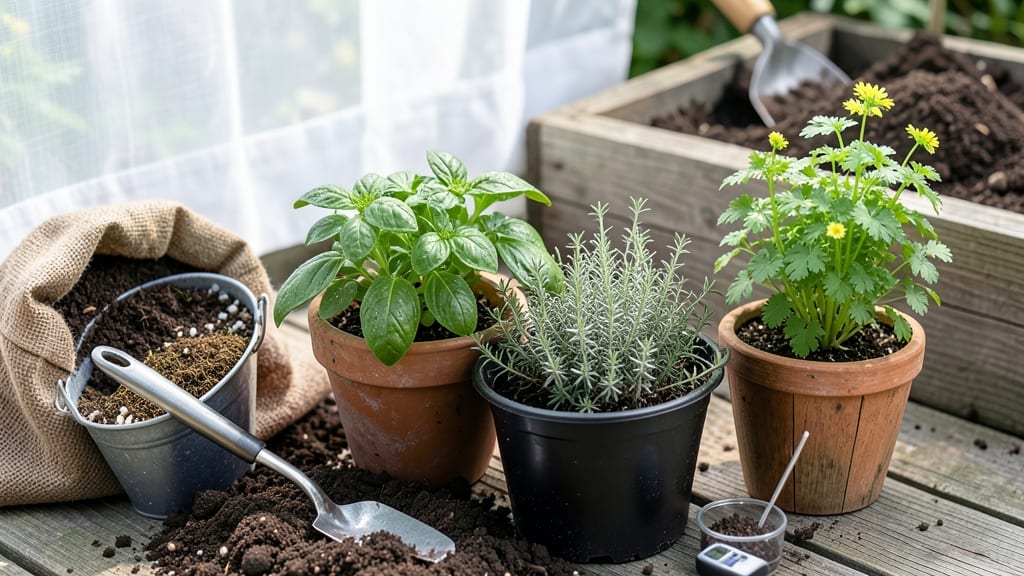
You can use raised bed soil in pots, but it requires adjustments: blend it with perlite or sand to improve drainage, and add compost to restore nutrients lost during repurposing. Never use unmodified heavy clay soils in containers.
Raised bed soil works well in pots once you account for two key differences: drainage and nutrient availability.
Containers dry out faster than in-ground beds, so amending with perlite or coarse sand prevents compaction and root rot. 🌱 The confined space also depletes nutrients quicker, which is why adding fresh compost (20-30% of the mix) is essential.
I’ve found that plants like herbs and lettuce thrive in this adjusted blend, while heavier feeders like tomatoes need even more compost or slow-release fertilizer.
For best results, test your raised bed soil first—if it’s too dense, mix in coco coir or vermiculite instead. The goal is to mimic the airy, well-draining environment roots need in pots. Always use pots with drainage holes to prevent waterlogging, and consider terracotta for its natural breathability.
💡 In This Article
- Why Raised Bed Soil Needs Modification for Containers
- Best Soil Mix Ratios for Potted Plants Using Raised Bed Soil
Why raised bed soil needs modification for containers
Raised bed soil behaves differently in pots because of how roots interact with confined spaces. In raised beds, soil compacts naturally under foot traffic and plant weight, creating air pockets that improve drainage over time.
But when you transfer that same soil to pots, the lack of movement causes it to become dense and waterlogged—roots suffocate because oxygen can't circulate properly. This is why plants in unmodified raised bed soil often show yellowing leaves or stunted growth within weeks.
The nutrient dynamics shift too. Raised beds benefit from regular topsoil replenishment, but pots hold only a finite volume. For example, a 10-gallon pot might contain 10-15 pounds of soil, while a raised bed has hundreds of pounds.
Nutrients like nitrogen and phosphorus deplete faster in containers, especially for heavy feeders like peppers or basil.
The confined root zone also causes salts to build up more quickly, stressing plants. 🔥 To combat this, I recommend adding well-aged compost (20-30% of the mix)—it not only restores nutrients but also improves soil structure by increasing porosity.
Moisture retention is another critical factor. Raised bed soil holds water longer due to its depth and exposure to natural evaporation cycles. In pots, however, the soil surface dries out 3-5 times faster—this is why even moisture-loving plants like ferns need amended soil.
Heavy clay soils from raised beds are particularly problematic in containers because they repel water when dry and suffocate roots when wet. The solution? Mix in perlite or coarse sand (30% of the blend)—these materials create macropores that prevent compaction and allow excess water to drain away.
Root systems also adapt differently in containers. In raised beds, roots can spread laterally and vertically without restriction, developing a robust network. But in pots, roots grow in a circular pattern, competing for the same limited resources.
This is why amended soil with better aeration helps roots explore the entire pot volume more efficiently. For instance, herbs like thyme or oregano—native to well-draining Mediterranean soils—thrive in a 50% raised bed soil + 30% perlite + 20% compost mix because it mimics their natural environment.
One common mistake is assuming all raised bed soil is the same. Sandy soils drain too quickly in pots, while loamy soils (ideal for raised beds) can become compacted.
To test your soil, perform a simple jar test: fill a jar with moist soil, shake it, and observe the layers after 24 hours. If the top layer is mostly sand (large particles), add more compost. If it’s mostly silt or clay (fine particles), increase perlite or vermiculite.
This visual test helps you adjust the blend before planting. ✨
Finally, consider the pot material itself. Terracotta pots, for example, wick moisture from the soil, which can accelerate nutrient depletion. Plastic pots retain moisture longer but may not provide the same breathability.
Always pair your amended soil with pots that have drainage holes—even the best soil mix can’t prevent root rot if water pools at the bottom. For heavy clay soils, I’ve found that adding 10% coco coir to the mix improves water retention without sacrificing aeration.