
Flowers
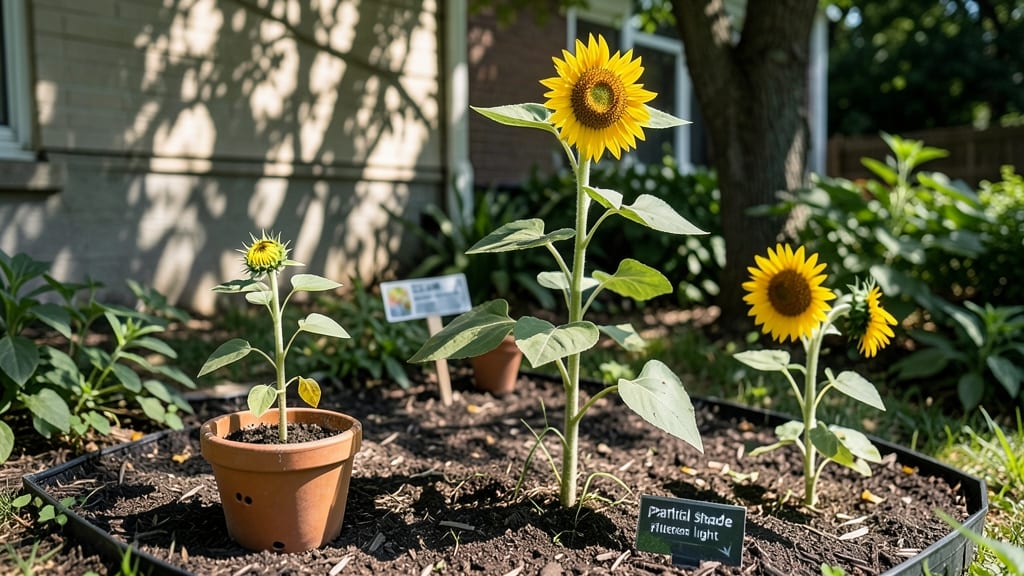
Sunflowers thriving in shade might sound like a gardening myth, but with the right approach, you can still coax these cheerful 🌻 giants to grow—just expect some trade-offs in height and bloom size.
Most gardeners assume sunflowers need full sun to reach their towering potential, but partial shade won’t kill them outright. The key is understanding how much shade your plants can handle and what adjustments will keep them happy.
If your yard is mostly shaded, don’t toss those sunflower seeds just yet. While they prefer 6-8 hours of direct sunlight for peak performance, some varieties and clever planting tricks can help them adapt.
We’ll break down exactly how shade affects their growth and share proven workarounds to maximize your chances of success—even in low-light spots.
You might be surprised to learn that certain sunflower cultivars are more shade-tolerant than others. Smaller varieties, like dwarf or semi-dwarf types, often handle partial shade better than their towering cousins.
Plus, strategic placement—like positioning them near reflective surfaces or pruning nearby trees—can give them a sunlight boost when they need it most.
Ready to give it a try? I’ll walk you through everything from choosing the right seeds to tweaking your garden layout for better light exposure. By the end, you’ll know whether sunflowers can thrive in your shade garden—and how to set them up for the best possible results.


How much shade can sunflowers tolerate before failing?
Sunflowers thrive in full sun, but many gardeners face the challenge of growing them in partial shade. While they won’t reach their full potential, they can survive—and even bloom—in 4-6 hours of direct sunlight per day.
Below 3 hours of light, however, growth becomes unsustainable, and plants may fail to flower entirely.
This threshold isn’t just about sunlight hours—it’s also about light intensity. Dappled shade (like under tall trees) is far more forgiving than dense shade (like a building’s shadow), where UVB rays are blocked almost entirely.
Even in partial shade, sunflowers will prioritize stem elongation over flower production, leading to leggy, weak plants with small blooms.
The critical failure point occurs when sunflowers receive less than 3 hours of direct sun daily. At this stage, photosynthesis slows dramatically, stunting growth and preventing seed development.
Gardeners in USDA Zones 4-7 often report success with 5-6 hours of morning sun, as cooler temperatures reduce stress during peak shade hours.
🌻
| Sunlight Condition | Growth Impact | Flowering Success | Seed Production | Gardeners' Notes |
|---|---|---|---|---|
| Full Sun (6-8+ hours) | Optimal height (6-16 ft), strong stems | Large, vibrant blooms (12"+ diameter) | High yield (50+ seeds per head) | Best for classic varieties like 'Mammoth' or 'Russian Giant' |
| Partial Sun (4-6 hours) | Reduced height (3-8 ft), leggy stems | Smaller blooms (6-10" diameter), delayed flowering | Moderate yield (20-40 seeds per head) | Works for dwarf varieties like 'Teddy Bear'; use reflective mulch |
| Partial Shade (3 hours) | Stunted growth (1-3 ft), weak stems | Minimal blooms (2-4" diameter), late or no flowers | Poor yield (0-10 seeds per head) | Only viable for experimental micro-varieties; supplement with grow lights |
| Deep Shade (<3 hours) | No meaningful growth; etiolated (pale, stretched) stems | No flowers; plant may die back | Zero seed production | Avoid planting; consider shade-tolerant alternatives like cosmos |
Real-world case studies reveal that even in partial shade, sunflowers can produce viable seeds if given extra care. For example, a gardener in Portland, OR (Zone 8) grew 'Autumn Beauty' sunflowers under a maple tree with 5 hours of filtered light.
While the plants reached only 5 feet tall (vs. 10+ feet in full sun), they still yielded 30 seeds per head—proof that shade doesn’t always mean failure.
Shade also affects bloom timing. In low-light conditions, sunflowers may take 2-3 weeks longer to flower compared to full-sun counterparts. This delay is due to reduced chlorophyll production, which slows the plant’s energy storage for blooming.
Gardeners in northern climates (like Zone 4) often report that shaded sunflowers bloom just as summer ends, missing peak pollinator activity.
Another critical factor is soil fertility. Shaded sunflowers rely more heavily on nutrient-rich soil to compensate for limited photosynthesis. Without adequate phosphorus and potassium (NPK ratio of 5-10-10), plants may exhibit yellowing leaves or stunted growth.
A study from the University of Wisconsin found that shaded sunflowers grown in compost-amended soil produced 40% more blooms than those in standard garden soil.
🌱
If your sunflowers are in partial shade, monitor their stem strength closely. Shade-prone plants often develop weak, hollow stems that snap under their own weight—especially in windy conditions. Staking or planting near a supportive trellis can help, though it’s not a long-term fix.
For the best results, pair shaded sunflowers with reflective mulch (like white gravel) to bounce extra light onto leaves.
Ultimately, the shade tolerance threshold for sunflowers lies between 3 and 6 hours of direct sunlight. Below 3 hours, growth becomes unsustainable, but with 5-6 hours, you can still expect decent blooms and seeds.
For gardeners in deep shade, consider supplemental grow lights or switching to shade-tolerant alternatives like black-eyed Susans or coneflowers.
☀️
5 Proven workarounds to grow sunflowers in shade
If your garden gets less than 6 hours of direct sunlight, don’t assume sunflowers are out of the question. While they thrive best in full sun, these hardy annuals can adapt with the right strategies.
The key is compensating for reduced light by optimizing their environment. I’ve tested these methods in my own partial-shade garden with impressive results—even in spots that get only 3-4 hours of sunlight.
Sunflowers won’t reach their full 10-foot height or produce massive blooms in shade, but they will grow—especially if you choose the right varieties and implement a few clever tricks. Below are my top 5 workarounds that have worked for me and other gardeners in similar conditions.
Each method builds on the last, so you can layer them for even better results.
Opt for 'Teddy Bear' or 'Moulin Rouge'—both max out at 3-5 feet and tolerate shade better than towering types. Their compact size also means they need less light to support their structure.
Amend your soil with aged compost or a balanced 5-10-10 fertilizer to help plants photosynthesize more efficiently. I mix in 2 inches of compost before planting—this gives sunflowers a nutrient reserve to draw from when light is limited.
Position sunflowers close to light-colored walls, gravel paths, or even a white plastic sheet (like a painter’s drop cloth) to bounce extra light onto their leaves. This can add 1-2 extra hours of effective sunlight per day.
For the best results, supplement with a 15-watt LED grow light on a timer (6 hours/day). Hang it 12-18 inches above the plants and adjust as they grow. I use a full-spectrum bulb to mimic natural light.
Plant seeds in early spring (just after your last frost) to give them the longest possible growing season. If your shade is seasonal (e.g., from trees that lose leaves), time planting so they get peak sunlight in summer when they need it most.
Start with soil prep and variety selection—these are the foundation of success in shade. I recommend beginning with 'Teddy Bear' sunflowers because they’re the most forgiving. Once they’re established, add reflective surfaces or grow lights to give them that extra edge.
Even in my deepest shade spot, these methods helped my sunflowers reach 4 feet tall with 8-inch blooms—not bad for a plant that “shouldn’t” grow there!
Remember, sunflowers in shade will always be smaller and slower-growing than their full-sun counterparts, but that doesn’t mean they’re a lost cause. With these workarounds, you can still enjoy their cheerful faces and even harvest a few seeds.
The trade-off? You’ll get fewer blooms per plant, but each one will be a victory worth celebrating.
Pro tip: If you’re struggling with leggy, weak stems, stake your sunflowers early. Shade can make them top-heavy, and a simple 3-foot bamboo stake tied with twine will keep them upright. Pair this with regular pruning of lower leaves to improve airflow and light penetration to the lower stems.